

Packed bed#
A packed-bed heat battery is a column filled with capsules of phase-change material (PCM),
with the heat transfer fluid flowing through the voids between them. The large surface of
the capsules makes heat transfer easy, and the capsules are simple to make and replace. The
family has one model, PackedBedModel, with options for the capsules.
Geometry#
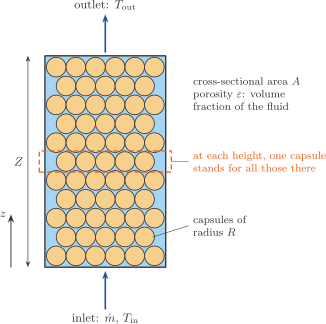
The packed bed. At each height, every capsule is the same, so one capsule stands for all those at that height.#
Symbol |
Parameter |
Meaning |
|---|---|---|
\(Z\) |
|
length of the bed along the flow |
\(A\) |
|
area of the bed cross-section |
\(\varepsilon\) |
|
volume fraction of the bed taken by the fluid |
\(R\) |
|
outer radius of a capsule |
The positions are \(z\), along the bed from the inlet, and \(r\), the distance from the centre of a capsule, from 0 to \(R\). The bed holds \((1 - \varepsilon) / (\tfrac{4}{3} \pi R^3)\) capsules per unit volume, with \(a = 3 (1 - \varepsilon) / R\) of capsule surface per unit volume.
The bed is a single flow path: the fluid flows through the voids, a flow area \(A_\mathrm{flow} = \varepsilon A\), carrying the whole mass flow rate \(\dot m\) (see the fluid). The model neglects the capsule shell (its thermal mass and resistance), conduction between capsules and along the bed in the PCM, dispersion in the fluid along the bed, and heat losses to the surroundings.
Equations#
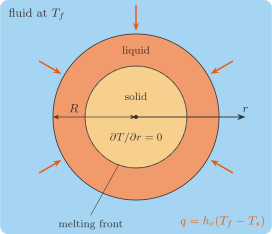
One capsule, melting from its surface inwards. Heat enters through the surface and is conducted radially.#
The formulation follows Brosa Planella (2025), which gives the details. Resolved along the bed, it is also known as the concentric dispersion model (Ismail and Henríquez, 2002). At each height \(z\), heat is conducted radially in a capsule:
with \(T_s = T|_{r = R}\), the temperature at the capsule surface. The fluid gains the heat that leaves the capsules at that height, \(q' = a A\, h_c (T_s - T_f)\) per unit length of bed.
Lumped capsules#
With options={"storage element": "lumped"}, each capsule has a uniform temperature: one
enthalpy per capsule, heated through its surface,
This is much cheaper, and accurate when conduction inside a capsule is fast compared with
heat transfer at its surface, that is when the capsule’s Biot number, \(\mathrm{Bi} = h_c R / k\),
is small. "lumped with Jeffreson" puts part of the neglected internal resistance back,
through an effective coefficient \(h_\mathrm{eff} = h_c / (1 + \mathrm{Bi} / 5)\)
(Jeffreson), with \(k\) the conductivity at the capsule’s enthalpy.
The correction is exact for slow changes in a sensible sphere, and an approximation while
the PCM melts or freezes.
Options#
Option |
Values |
|---|---|
|
|
|
|
|
|
The options combine: an averaged bed of lumped capsules is one well-mixed capsule for the
whole bed. In this family, the cross-section averages along the bed (such as
"Storage cross-section average temperature [K]") are the volume averages over a capsule.
The model also gives the device totals per unit cross-sectional area of the bed, such as
"Power per unit area [W.m-2]". The averaged bed is the reduced model of the
encapsulated-LTES repository.
Parameter sets#
The default parameter values are the experiments of
Nallusamy et al. (2007): a 47 l tank of
paraffin capsules, charged with water at 70 °C. A second set, "Raul2018", gives the
experiments of Raul et al. (2018),
with a heat transfer oil at 180 °C. See pytes.parameter_layers.
Examples#
Packed-bed model, against the measurements of Nallusamy et al. (2007)
Validation, against Schumann’s analytical solution
References#
F. Brosa Planella, A simple model for latent thermal energy storage systems with encapsulated phase-change material, International Journal of Heat and Mass Transfer 239, 126533 (2025), doi:10.1016/j.ijheatmasstransfer.2024.126533.
K. A. R. Ismail and J. R. Henríquez, Numerical and experimental study of spherical capsules packed bed latent heat storage system, Applied Thermal Engineering 22, 1705–1716 (2002), doi:10.1016/S1359-4311(02)00080-7.