

Lumped capsule#
By default the packed-bed model resolves the temperature across each capsule. With
options={"storage element": "lumped"} each capsule has a uniform temperature instead: one
enthalpy per capsule, heated through its surface. This is much cheaper, and accurate when
conduction inside a capsule is fast compared with heat transfer at its surface, that is when
the capsule’s Biot number, Bi = h R / k, is small.
"lumped with Jeffreson" puts part of the neglected internal resistance back, through the
heat transfer coefficient: h_eff = h / (1 + Bi / 5), whichever coefficient the “heat
transfer coefficient” option gives.
import matplotlib.pyplot as plt
import numpy as np
import pybamm

import pytes

variants = {
    "resolved": {},
    "lumped": {"storage element": "lumped"},
    "lumped with Jeffreson": {"storage element": "lumped with Jeffreson"},
}


def charge(options, conductivity=None):
    """The default charge (Nallusamy et al., 2007), optionally with other capsules"""
    model = pytes.PackedBedModel(options=options)
    parameter_values = model.default_parameter_values
    if conductivity is not None:
        for phase in ("solid", "liquid"):
            parameter_values[f"PCM {phase} phase conductivity [W.m-1.K-1]"] = (
                conductivity
            )
    t_end = 160 * 60
    return pybamm.Simulation(model, parameter_values=parameter_values).solve(
        [0, t_end], t_interp=np.linspace(0, t_end, 321)
    )


def compare(conductivity=None):
    fig, ax = plt.subplots(figsize=(6, 4))
    for label, options in variants.items():
        solution = charge(options, conductivity)
        print(f"{label}: solve time {solution.solve_time}")
        ax.plot(
            solution["Time [min]"].entries,
            solution["Outlet temperature [degC]"].entries,
            label=label,
        )
    ax.set_xlabel("Time [min]")
    ax.set_ylabel("Outlet temperature [°C]")
    ax.legend()
    plt.show()


values = pytes.PackedBedModel().default_parameter_values
h = values["Heat transfer coefficient [W.m-2.K-1]"]
R = values["Capsule radius [m]"]
for phase in ("solid", "liquid"):
    k = values[f"PCM {phase} phase conductivity [W.m-1.K-1]"]
    print(f"Biot number, {phase}: {h * R / k:.1f}")
compare()
Biot number, solid: 6.9
Biot number, liquid: 18.3
resolved: solve time 1.668 s
lumped: solve time 9.730 ms
lumped with Jeffreson: solve time 5.921 ms
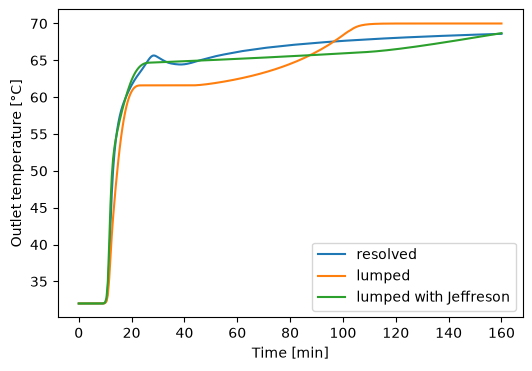
The paraffin capsules of the default set have Biot numbers of 7 to 18: far too large to lump. The lumped capsule takes heat much faster than the resolved one, as nothing slows the heat on its way into the capsule: its outlet stays colder while the PCM melts, and the bed is fully charged after about 105 minutes instead of more than 160. Jeffreson’s correction follows the resolved outlet for the first half hour, but then charges too slowly: one effective coefficient cannot follow a melting front moving into the capsule.
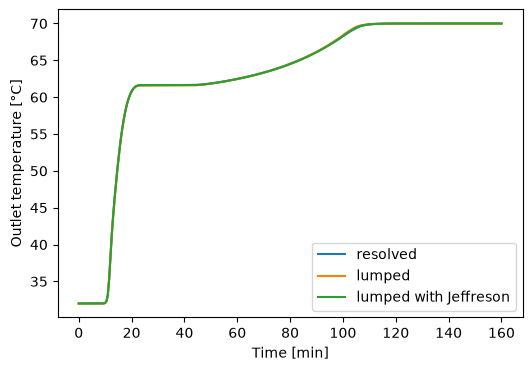
With capsules a hundred times more conductive (k = 40 W.m-1.K-1, Bi about 0.07), as
with a conductive filler, the three agree closely, and the lumped capsules solve hundreds
of times faster.
compare(conductivity=40)
resolved: solve time 6.883 s
lumped: solve time 9.710 ms
lumped with Jeffreson: solve time 10.630 ms
Energy is conserved exactly whichever variant is used, and the lumped option combines with
"storage along flow path": "averaged" (one well-mixed capsule for the whole bed) and with
any heat transfer coefficient. On Schumann’s benchmark, with sensible capsules, the lumped
bed is Schumann’s model itself (see the validation notebook).