

Finned tube#
A finned-tube heat battery is a block of phase-change material (PCM) crossed by \(N\)
parallel tubes that carry the heat transfer fluid. Thin metal fins, annular discs around
each tube, carry the heat into the PCM, which conducts poorly on its own. The family has
two models: the SharpFrontModel, which homogenises the fins and the PCM,
and the MushModel, which resolves them separately. Both are derived, by
homogenisation, in Luckins and Brosa Planella (2025).
Geometry#
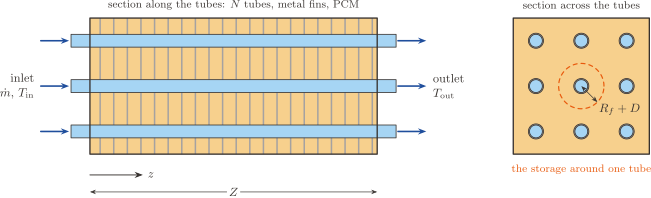
The device, along and across the tubes. All the tubes are the same, so the models describe one tube and the storage around it.#
The models describe one tube and multiply the device totals by the number of tubes. The storage around a tube reaches out to a radius \(R_f + D\), about half the distance to the next tube, where no heat crosses by symmetry. In the models, it is an annulus around the tube.
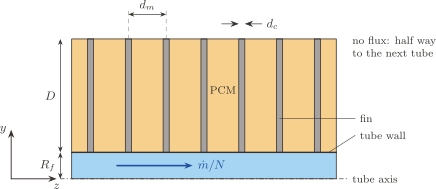
The storage around one tube, in half a section along it: the fluid flows along the tube (\(z\)), and the fins and the PCM extend from the tube wall (\(y = R_f\)) to \(y = R_f + D\).#
Symbol |
Parameter |
Meaning |
|---|---|---|
\(N\) |
|
tubes in the device, in parallel |
\(Z\) |
|
length of the flow path |
\(R_f\) |
|
inner radius of a tube |
\(D\) |
|
extent of the storage from the tube wall |
\(d_c\) |
|
thickness of a fin |
\(d_m\) |
|
distance between the centres of consecutive fins |
\(\delta\) |
\(d_c / d_m\) |
volume fraction of the fins |
The positions are \(z\), along the tube from the inlet; \(y\), the distance from the tube axis, from \(R_f\) to \(R_f + D\); and, in the mush model only, \(x\), the distance from the centreline of a fin, across the gap to the next one.
The fluid flows in a tube of flow area \(A_\mathrm{flow} = \pi R_f^2\), carrying \(\dot m / N\) (see the fluid). Both models neglect conduction along the tube in the storage, the thermal mass and resistance of the tube wall (other than the heat transfer coefficient), and heat losses to the surroundings.
Sharp-front model#
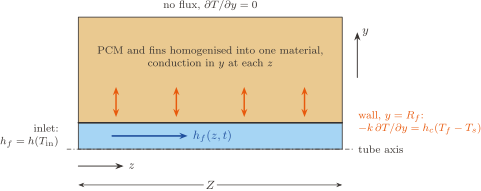
The sharp-front model: the PCM and the fins as one material, conducting heat radially at each position along the tube.#
The PCM and the fins are homogenised into one composite material: its heat capacities are volume averages, \(\rho c = \delta\, \rho c_\mathrm{metal} + (1 - \delta)\, \rho c_\mathrm{PCM}\), its latent heat is \((1 - \delta)\, \rho L_\mathrm{PCM}\), as only the PCM melts, and its conductivity is \(k = \delta\, k_\mathrm{metal} + (1 - \delta)\, k_\mathrm{PCM}\), the parallel arrangement, for heat flowing along the fins. At each position \(z\), heat is conducted radially:
with \(T_s = T|_{y = R_f}\). The fluid gains the heat that crosses the wall, \(q' = 2 \pi R_f\, h_c (T_s - T_f)\) per unit length of tube. With a sharp melting point and no smoothing, the melting front is sharp, hence the name.
Mush model#
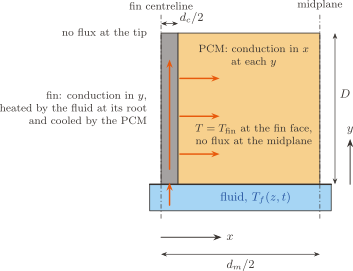
The mush model, at one position along the tube: heat flows from the fluid into the root of a fin, along the fin (\(y\)), and from the fin into the PCM on either side (\(x\)). By symmetry, half a fin and half a gap are modelled.#
The mush model (Luckins and Brosa Planella, 2025) resolves the fins and the PCM separately, at each position \(z\) along the tube. Heat flows from the fluid into the root of each fin, radially along the fin, and from the fin into the PCM between it and the next fin. The PCM uses the properties of the PCM on its own. By symmetry, half the gap is modelled, from the face of the fin (\(x = d_c / 2\)) to the midplane (\(x = d_m / 2\)).
In the PCM, heat is conducted across the gap only, at each \(y\):
In the fins, heat is conducted radially, and the fin gains the heat the PCM on both sides gives up through its faces:
The heat the fluid exchanges over one fin pitch of wall enters through the fin root alone, so the flux into the root is \(d_m / d_c\) times the flux at the wall, and no heat crosses the tip:
The fluid again gains \(q' = 2 \pi R_f\, h_c (T_\mathrm{fin}|_{y = R_f} - T_f)\) per unit length of tube. The PCM does not touch the tube wall, and no heat flows through it radially or along the tube.
The mush model is three-dimensional (\(x\), \(y\), \(z\)), and much slower than the sharp-front model. With thin, closely spaced fins the two agree closely (Tutorial 2); the mush model is the one to use when the fins are thicker or further apart, or when the temperature between the fins matters.
Options#
Option |
Values |
|---|---|
|
|
|
|
The averaged sharp-front model is one-dimensional (\(y\)), and the averaged mush model two-dimensional (\(x\), \(y\)).
Examples#
References#
E. K. Luckins and F. Brosa Planella, Homogenized models for composite phase-change materials, Proceedings of the Royal Society A 481, 20250660 (2025), doi:10.1098/rspa.2025.0660.